“Train up a child in the way he should go: And when he is old, he will not depart from it.” — Prov. 22:6
If you’ve landed here without reading my previous blog, you’ll be missing the back story to this one. Click here to go back to the back story!
My early childhood was spent on a Canadian army base. We had become a family of five; mom and dad plus three children. My brother was nine years older than me. My sister was 16 months older. I was the baby, also known as the black sheep of the family. I thought it was because my hair was black. I was wrong.
It was the 50’s so my dad pretty much ruled the roost in our family and made most of the decisions. There was, however, one area where my mother clearly reigned supreme: Church. It always amazed me how my father, this 5’ 2” bigger-than-life king of our castle could turn into a complete wimp on Sunday mornings.
“We’re going to be late for church!” my mother would shriek at me as I dawdled to get ready on Sunday mornings. “It’s a sin to miss church”, she would threaten. There was absolutely no reason my mother would accept as being good enough to stay home from church. Believe me, I tried.
Road trips were no exception. I remember when we would be trolling the streets of some Podunk little town, my father sulking at the wheel of our car, until we found a Catholic church that was serving up Sunday mass. One was always found. And females always had to wear hats in church. No hats for us girls on this road trip? No problem. My mom would simply bobby pin facial tissues to cover our heads. Problem solved.
I dreaded going to church — having to keep quiet and sit still. Sunday School was a foreign concept to we Catholics. Children endured the whole ‘mass’. No Bible characters on felt boards for us, no stories, no colouring pictures. We were hard core.
My earliest memories of being in church, at age four or five, was sitting next to my mother and her pinching my thigh with enough pressure to pop a giant pimple. All this was perpetrated against my person in a bid to stop me from giggling at something that somehow managed to hit my funny bone.
And it was always the same, like “Groundhog Day”. Cue the organ. Cue the singing. Cue the priest prattling on, sometimes in Latin. Cue the congregation responding to him with a low rumble of words, indiscernible to the naked ear. Cue the sermon (that was the worst part). Cue the standing up, and the sitting down. Cue the kneeling at the altar to receive communion, and finally, with blessed relief, 20 excruciating minutes later, cue the organ as we filed out of church.
To a wiggly, busy little girl with far better things to do, the whole ordeal was torture. Later, into my adolescence, there would be more rules to follow, more obligations to meet to be a good Catholic. I was not off to a great start.
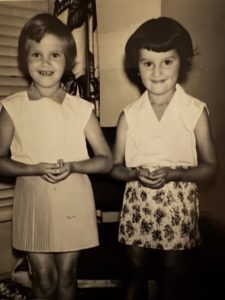
Enter, stage left, my sister, Aurélie (pronounced or rey lee). Her memories of church were quite different. She told me recently: “Sometimes I didn’t want to go [to church] but being an obedient little girl I always went, even when I was a teenager”.
I saw my sister’s role in our family as parent-pleaser and peacemaker; the kid who rarely got into trouble. She was the one against whom my ‘goodness’ would be measured. ‘Why can’t you be more like your sister?’ Not going to happen.
Our parents said we fought ‘like cat and dog’, but we have always been very close. As we were growing up, Aurélie filled in as a mother figure with her endless supply of hugs and kisses. She would come to my aid, comforting me when the stresses all became too much.
I, on the other hand, was a pint-sized non-conformist who always wanted to know: Why? Why do we have to go to church every Sunday? Why do I have to eat onions? I felt strongly about both.
I was also one of those hyper-sensitive children. I picked up on all the stresses and strains between my parents and acted out, not meaning to but ultimately pushing every button on my mother’s already fragile nerves.
I perceived my mother as cold and critical. My sister doesn’t recall much about our mother when we were little and what she does remember is usually quite positive. I’ve come to believe that two children, raised by the same parents in the same household at the same time can experience very different childhoods.
My father certainly had his faults, but he was an affectionate and attentive parent when we were young. He loved to give his girls ‘bear hugs’ and to tickle us silly. When my dad looked at me, I think he saw a little girl with spirit. I think my mother saw trouble.
Not surprisingly, I was a Daddy’s Girl. This did not endear me to my mother who knew a man quite different from the one I did. To make things worse, I got along well with boys from an early age and included them in my circle of friends. My mother did not approve, looking at me with suspicion.
It was around this time, age seven, that my mother began to accuse me of having ‘loose morals’, calling me names I didn’t understand, but that I could tell from the look on her face, were not meant to be kind. Looking back, I can see that my mother was ascribing to me the very traits she saw in my dad. I felt that in her eyes, I truly was the black sheep of the family. If only she’d read in my diary what I wrote about boys, she wouldn’t have worried about me because I was basically a good kid.
Now here’s the thing — the way she singled me out for her ire did not square with the God-fearing, churchgoing-woman of deep faith that I knew her to be. Because there was another side to her.
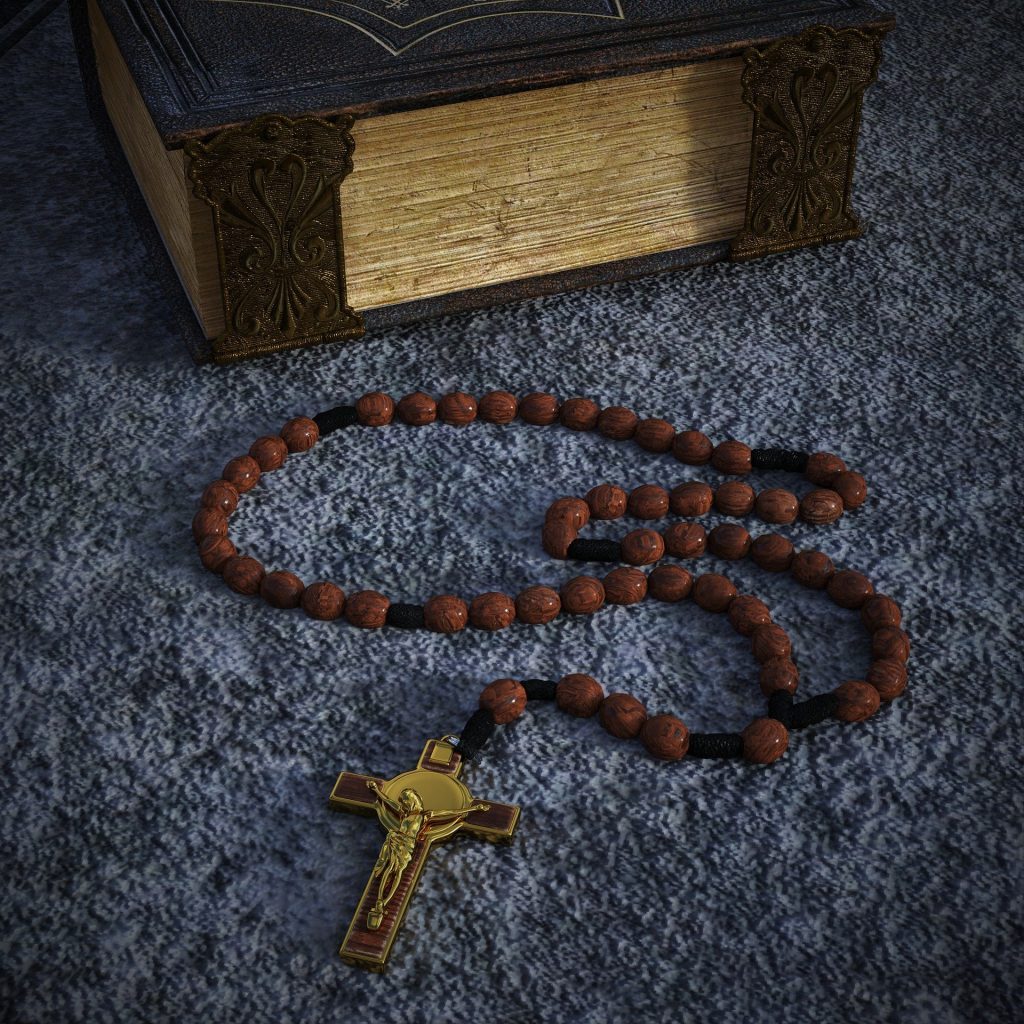
The mother I knew also modelled for me an unshakeable faith. Every time I complained about a problem I was having, her reply was always “we must have faith in ‘le bon Dieu’, our Saviour. We must pray.” She prayed every night, her prayer book kept under her pillow, dog-eared and worn. Her rosary beads were often in her hands, as worn as her prayer book.
However, these early years had left their mark and finally, at the age of 15, things came to a head. My mother expected me to do the customary Christmas visit to the confessional and I said no. I couldn’t see the point in going to a priest to ask for forgiveness for my sins when I could confess them directly to God, and I told her so. Her reply was a hard slap to my face.
That was it. I’d had enough of her expectations, and she’d had enough of me not meeting them. I didn’t go to the confessional that night, or ever again. But I did go to church, tears streaming down my face as I confessed my sins to God, alone in my pew.
It was a turning point for me. After that night I attended church on my own terms, deciding if or when I wanted to go, which wasn’t very often. I had come to associate ‘church’ with my mother.
Well, everyone, thank you for reading this first chapter in the story of my journey back to church. Before I sign off, I just want to add that I’m so keenly aware that my story of childhood trauma may pale in comparison to yours. If that’s so, my heart goes out to you. It really does.
I would welcome your comments about my story and for those who feel able, something from your own childhood experiences.
Next time, I’ll tell you the rest of my story about growing up Catholic. It has a surprise twist.